Free Online Calculators: Best Calculators for Everyday Use
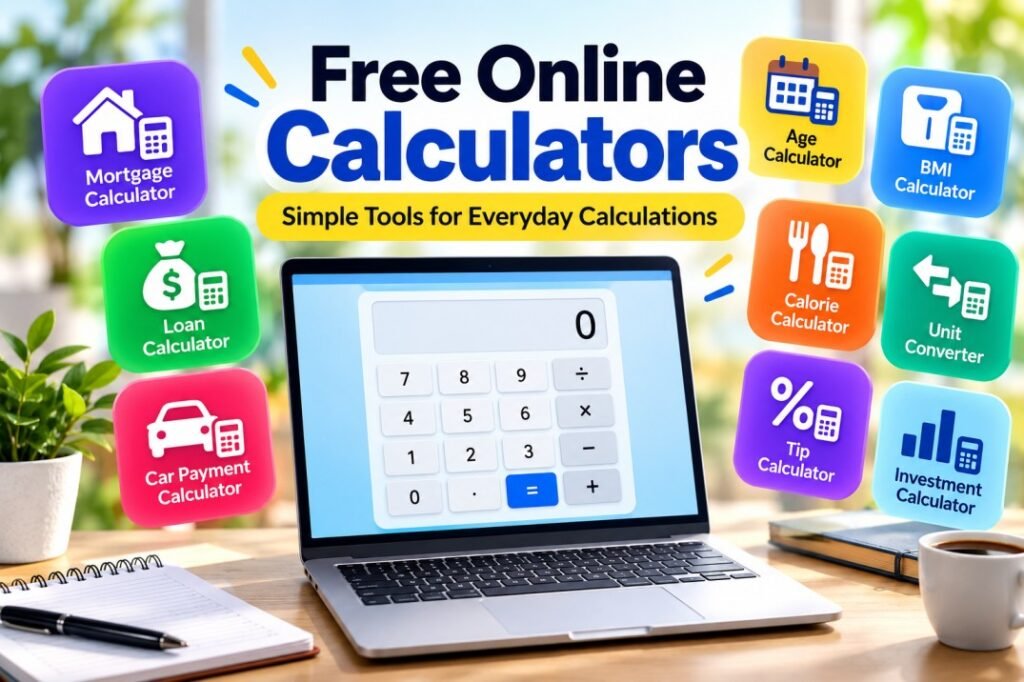
Free online calculators make everyday calculations much easier. Whether you are checking a percentage, estimating a monthly payment, calculating your age, or converting measurements, you can get the result without doing complicated math by hand.
The useful thing about an online calculator is speed. You enter the numbers, choose the calculation you need, and get an answer in seconds. Some tools are designed for simple everyday tasks, while others can help with personal finance, health, education, and unit conversion.
In this guide, we’ll look at some of the most useful calculators you can use online, including mortgage, loan, calorie, age, investment, retirement, and conversion tools. We’ll also explain what each calculator is useful for and when you should use it.
What Are Free Online Calculators?

Free online calculators make everyday calculations much easier. Whether you are checking a percentage, estimating a monthly payment, calculating your age, or converting measurements, you can get the result without doing complicated math by hand.
The useful thing about an online calculator is speed. You enter the numbers, choose the calculation you need, and get an answer in seconds. Some tools are designed for simple everyday tasks, while others can help with personal finance, health, education, and unit conversion.
In this guide, we’ll look at some of the most useful calculators you can use online, including mortgage, loan, calorie, age, investment, retirement, and conversion tools. We’ll also explain what each calculator is useful for and when you should use it.
Types of Free Online Calculators
Not every calculation requires the same type of tool. That is why online calculators are usually built around a specific task or problem. From everyday math to personal finance and measurement conversions, choosing the right calculator can make the process much easier.
Basic and Everyday Calculators
A standard calculator is useful for quick calculations such as addition, subtraction, multiplication, division, percentages, and basic mathematical operations. It is a good option when you simply need an answer without working through the calculation manually.
Financial Calculators
Financial calculators can help with decisions involving money. A mortgage calculator can estimate potential monthly home-loan payments, while a loan calculator can help you understand how loan amount, interest rate, and repayment period can affect the overall cost.
For vehicle financing, a car payment calculator can provide an estimate of monthly payments based on the vehicle price, down payment, interest rate, and loan term.
Health and Fitness Calculators
Health-related tools can provide quick estimates based on information you enter. For example, a calorie calculator can estimate daily calorie needs using details such as age, height, weight, activity level, and other inputs.
These results should be treated as estimates rather than medical advice, especially when making health or nutrition decisions.
Date, Age, and Time Calculators
Need to know your exact age or calculate the time between two dates? An age calculator can do this automatically using your date of birth and a selected date.
Other date and time tools can help calculate the number of days between dates, working hours, or the duration between two times.
Conversion Tools
Conversion calculators are useful when you need to change one measurement into another. Unit conversion tools can handle measurements such as length, weight, temperature, area, volume, and speed.
For example, you can convert inches to centimeters, miles to kilometers, pounds to kilograms, or Fahrenheit to Celsius without manually looking up conversion formulas.
These different calculator types make it easier to handle everyday calculations without needing specialized software.
Best Calculator for Everyday Math
For simple calculations, you usually do not need a specialized tool. A standard calculator can handle most everyday math problems quickly and accurately.
You can use it for basic operations such as adding expenses, subtracting amounts, multiplying quantities, dividing costs, or checking percentages. This makes an online calculator useful for students, shoppers, homeowners, and anyone who needs a quick calculation.
Percentage Calculations
Percentage calculations are common in everyday situations. You might need to calculate a discount, compare prices, work out a percentage increase, or find out what portion one number represents of another.
Instead of manually applying a formula, an online calculator can give you the result immediately. This can be especially helpful when you are comparing several numbers or checking your own calculation.
When Should You Use a Basic Calculator?
A basic online calculator is useful when:
- You need a quick mathematical answer
- You want to double-check a calculation
- You are calculating prices or expenses
- You need to work with percentages
- You want to avoid manual calculation errors
- You are working with numbers on your phone or computer
For more advanced calculations, however, it is better to use a specialized calculator designed for that particular task.
Mortgage and Loan Calculators
When you are planning a major purchase or borrowing money, it can be difficult to understand how much you may need to pay each month. Financial calculators can make these estimates easier by putting the important numbers into one place.
Mortgage Calculator
A mortgage calculator can help estimate a potential monthly mortgage payment based on factors such as the home price, down payment, interest rate, and loan term.
It can be useful when comparing different home prices or considering how a change in the interest rate could affect your monthly payment. Some mortgage calculators may also include estimates for property taxes, homeowners insurance, and other costs.
Loan Calculator
A loan calculator is useful for estimating payments on different types of loans. You can typically enter the loan amount, interest rate, and repayment period to see an estimated monthly payment and total interest.
This can help you compare different loan scenarios before making a financial decision.
Car Payment Calculator
If you are planning to finance a vehicle, a car payment calculator can estimate your potential monthly payment. You can enter the vehicle price, down payment, interest rate, and loan term to see how the numbers change.
Keep in mind that calculator results are estimates. Actual rates, fees, taxes, insurance, and lender terms can affect the final amount you pay.
Health and Fitness Calculators
Online health calculators can be useful when you want a quick estimate based on information such as your age, height, weight, and activity level. They are especially convenient because you can enter your details and get a result without doing the calculations yourself.
Calorie Calculator
A calorie calculator can estimate how many calories a person may need each day based on factors such as age, height, weight, activity level, and goals.
For example, someone trying to maintain their current weight may have different estimated calorie needs than someone who wants to lose or gain weight. These calculators are useful for general guidance, but individual nutritional needs can vary.
BMI Calculator
A BMI calculator can estimate your body mass index using your height and weight. It is commonly used as a general screening measurement rather than a complete assessment of health.
Because BMI does not account for every factor, such as muscle mass or body composition, its result should be interpreted carefully.
When to Use Health Calculators
Health and fitness calculators can be helpful for:
- Getting quick general estimates
- Tracking personal goals
- Understanding basic measurements
- Planning a fitness routine
- Comparing changes over time
For medical, nutritional, or weight-related decisions, online calculator results should not replace advice from a qualified healthcare professional.
Investment and Retirement Calculators
Planning for the future often involves numbers that are difficult to calculate manually. Investment and retirement calculators can make these estimates easier by showing how different amounts, time periods, and rates may affect your financial goals.
Investment Calculator
An investment calculator can help estimate how an investment might grow over time. Depending on the tool, you may be able to enter an initial investment, regular contributions, estimated return rate, and investment period.
This can be useful when comparing different saving or investing scenarios. Remember that projected returns are estimates and actual investment performance can be different.
Retirement Calculator
A retirement calculator can help you estimate how much you may need to save for retirement. It may consider factors such as your current savings, regular contributions, expected returns, retirement age, and estimated expenses.
Using different assumptions can help you understand how increasing your savings or changing your retirement timeline could affect the projection.
Why Use These Calculators?
Investment and retirement calculators are useful for:
- Comparing different savings scenarios
- Estimating long-term growth
- Setting financial goals
- Understanding the effect of regular contributions
- Planning for future expenses
These tools are best used for general planning rather than as a guarantee of future financial results.
Age, Date, and Time Calculators
Calculating dates manually can become surprisingly confusing, especially when you need to account for different months, leap years, or specific time periods. Online date and time tools make these calculations much quicker.
Age Calculator
An age calculator can determine a person’s age from their date of birth. Depending on the tool, it can show the result in years, months, and days.
It can be useful for checking birthdays, completing forms, planning events, or simply finding your exact age on a particular date.
Date Calculator
A date calculator can help you find the number of days between two dates or determine a future or past date by adding or subtracting a specific number of days.
This can be helpful when planning trips, tracking deadlines, calculating project durations, or working with important dates.
Time Calculator
A time calculator can help you add or subtract hours and minutes, calculate the duration between two times, or work out total working hours.
These tools are particularly useful for schedules, timesheets, projects, and everyday time planning.
Using an online calculator for date and time calculations can save you from manually counting days or converting hours and minutes.
Unit Conversion Tools
Different countries, industries, and situations use different measurement systems. That is where unit conversion tools can save time. Instead of remembering conversion formulas, you can enter a value and quickly convert it into the measurement you need.
Common Unit Conversions
An online conversion tool can be useful for everyday measurements such as:
- Inches to centimeters
- Centimeters to inches
- Feet to meters
- Meters to feet
- Miles to kilometers
- Kilometers to miles
- Pounds to kilograms
- Kilograms to pounds
- Fahrenheit to Celsius
- Celsius to Fahrenheit
- Gallons to liters
For example, someone working with measurements in the United States may need to convert feet or inches into centimeters when working with metric measurements. A conversion tool can provide the result instantly without requiring manual calculations.
Why Use an Online Conversion Tool?
A unit converter is especially useful when you work with measurements regularly or need to switch between US customary and metric units. It can help reduce calculation mistakes and make everyday conversions much faster.
Whether you are checking a recipe, comparing distances, working on a home project, or dealing with international measurements, a simple conversion tool can make the process much easier.
How to Choose the Right Online Calculator
With so many calculator options available, choosing the right one depends on what you are trying to calculate. A good online calculator should be simple to understand, provide clear results, and require only the information necessary for the calculation.
1. Choose a Calculator for Your Task
Start by identifying what you need to calculate. For example, use an age calculator for date-of-birth calculations, a loan calculator for borrowing estimates, or a unit conversion tool when you need to change one measurement into another.
2. Check the Inputs
Before calculating, make sure the information you enter is correct. A calculator can only provide a useful result when the numbers and units are accurate.
3. Understand the Result
Do not look at the final number alone. Check what the result represents and whether the calculator includes assumptions such as interest rates, estimated returns, or activity levels.
4. Use the Right Calculator
For more detailed calculations, a specialized tool is usually better than a basic calculator. For example, someone planning long-term savings may get more useful information from an investment calculator or retirement calculator than from a standard math tool.
The best online calculator is ultimately the one that matches your specific task and gives you an easy-to-understand result.
enefits of Using Free Online Calculators
The main advantage of free online calculators is convenience. Instead of searching for formulas or performing several steps manually, you can enter your information and get an estimate within seconds.
Save Time
Online calculators can handle calculations instantly, which is especially useful when you need to repeat the same type of calculation several times.
Reduce Manual Errors
Complex calculations can be easy to get wrong when done by hand. A well-designed calculator can perform the formula consistently and show the result clearly.
Easy to Use on Any Device
Most online calculators work directly in a web browser, so you can use them on a desktop, laptop, tablet, or smartphone without installing additional software.
Useful for Different Needs
From a simple tip calculator for a restaurant bill to financial, health, and measurement tools, online calculators can help with many everyday tasks.
Free and Accessible
Many calculator tools are available at no cost and do not require an account. This makes them convenient when you need a quick answer without downloading an application.
For best results, always check the information you enter and understand what the calculation represents before using it to make an important decision.
Are Online Calculators Accurate?
In most cases, a well-designed online calculator can provide accurate results when the correct information is entered. However, the quality of the result depends on the formula used by the tool and the accuracy of the information you provide.
For example, a mortgage calculation may use an interest rate and loan term that are different from the actual terms offered by a lender. Similarly, health calculators provide general estimates based on the information entered and may not reflect every individual factor.
Check Your Information
Before clicking the calculate button, make sure your numbers, dates, units, and other inputs are correct. Even a small mistake in the input can change the final result.
Understand That Some Results Are Estimates
Financial, health, investment, and retirement calculators often provide estimates rather than guaranteed outcomes. Interest rates, investment returns, taxes, fees, and personal circumstances can change over time.
For simple math and basic conversions, the result is generally straightforward. For important financial or health decisions, however, it is better to use the calculator as a starting point and verify the information when necessary.
Use Calculators as a Helpful Starting Point
The purpose of an online calculator is to make calculations easier—not to replace professional advice. When the result could affect an important financial, medical, or legal decision, consider confirming it with a qualified professional.
Tips for Getting Better Results from Online Calculators
Getting the correct result is not only about choosing a calculator. The information you enter also matters. A few simple checks can help you get more reliable results from any online tool.
Enter Accurate Information
Always double-check the numbers before calculating. For example, when using a car payment calculator, make sure the vehicle price, down payment, interest rate, and loan term are entered correctly.
Select the Correct Units
When working with measurements, confirm that you have selected the right units before entering a value. This is particularly important when using a conversion tool for inches, feet, miles, kilograms, or temperature.
Compare Different Scenarios
One useful feature of calculators is the ability to test different numbers. You can change the loan term, savings amount, interest rate, or other inputs and compare the results.
For example, changing the repayment period in a loan calculation can show how a longer or shorter term may affect estimated payments.
Don’t Rely on One Number Alone
A calculator gives you a result based on the information and formula it uses. For important decisions, consider the assumptions behind that result and verify the details from a reliable source.
Using calculators this way makes them more useful for planning while helping you avoid misunderstandings or incorrect assumptions.
Free Online Calculators for Different Everyday Needs
The biggest advantage of having multiple free online calculators in one place is that you do not have to search for a different tool every time you need to solve a new problem. Whether you are checking a bill, planning a purchase, tracking fitness goals, or converting measurements, there is usually a calculator designed for the task.
For Personal Finance
Use a mortgage calculator, loan calculator, car payment calculator, or investment calculator when you need to explore different financial scenarios. These tools can help you compare numbers before making a decision.
For Health and Fitness
A calorie calculator can provide an estimated daily calorie requirement, while other fitness calculators can help with measurements and general planning.
For Dates and Time
An age calculator is useful for calculating age from a date of birth, while date and time tools can help you find the difference between dates or calculate working hours.
For Measurements
Use unit conversion tools when you need to switch between measurement systems. They are particularly useful for length, weight, temperature, distance, and volume conversions.
For Everyday Spending
A tip calculator can quickly help you work out a restaurant tip and split a bill between multiple people. Similarly, a discount calculator can help you understand the final price after a percentage discount.
With the right tool, many calculations that normally take several steps can be completed in just a few seconds.
Free Online Calculators vs. Manual Calculations
Manual calculations can be useful for simple math, but they can become time-consuming when a formula has several steps. Free online calculators provide a quicker way to handle these calculations while reducing the amount of work you need to do yourself.
Faster Results
Instead of looking up a formula and calculating each step manually, you can enter your information into the appropriate tool and receive a result almost instantly.
Easier for Complex Calculations
A specialized calculator can handle formulas that may be difficult to calculate by hand. This is especially useful for mortgage payments, loans, investments, percentages, and measurement conversions.
Easy to Recheck
One benefit of online tools is that you can change an input and calculate again. This makes it simple to compare different scenarios without starting the entire calculation from scratch.
Manual Calculations Still Have a Place
For basic math, understanding the underlying calculation is still useful. Online tools should make the process more convenient rather than prevent you from understanding what the numbers mean.
For important decisions, always review the inputs, assumptions, and final result instead of relying on a calculator output without context.
Conclusion
Free online calculators can make everyday calculations faster, simpler, and easier to understand. Instead of working through formulas manually, you can choose a calculator designed for the specific task and get a result in seconds.
From a basic calculator for everyday math to a mortgage calculator, loan calculator, calorie calculator, age calculator, or unit conversion tool, each option can save time when you need a quick calculation.
For financial planning, tools such as an investment calculator, retirement calculator, and car payment calculator can help you explore different scenarios. For everyday spending, a tip calculator can make bill calculations much easier.
The important thing is to use the right tool, enter accurate information, and understand whether the result is an exact calculation or simply an estimate.
As you build your own collection of useful calculators, having these tools available in one place can make everyday tasks much more convenient.